MENUMENU

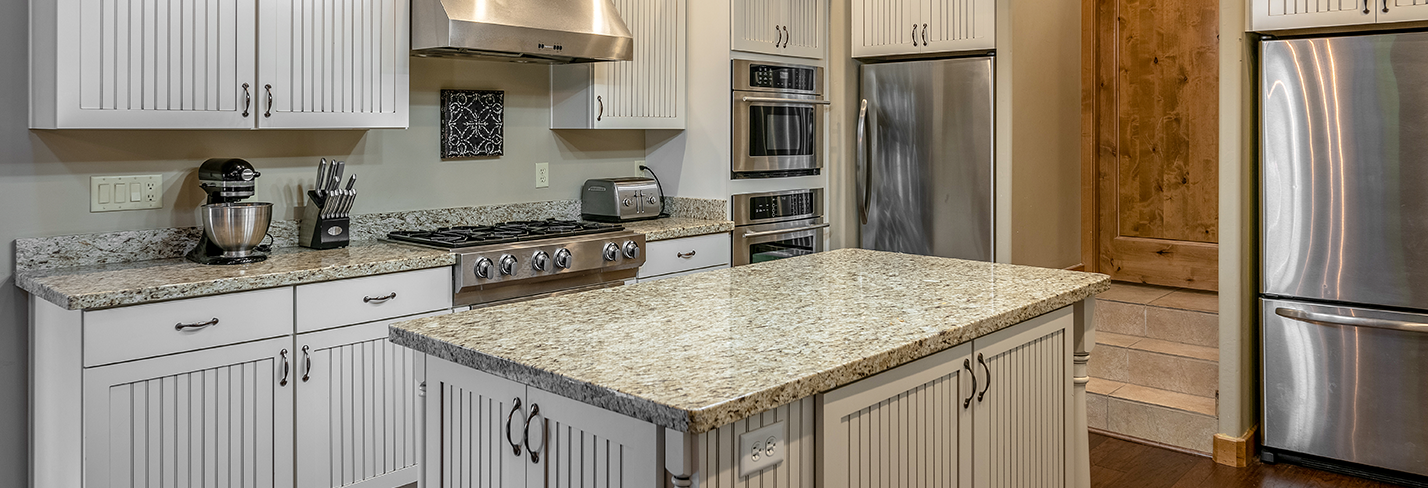
Kitchen countertops take a lot of daily wear and tear. Between meal prep, spills, hot pans, cleaning products, and normal wear, it is common for homeowners to eventually notice stains, cracks, dull areas, sagging sections, or an outdated appearance.
The difficult part is knowing what those signs actually mean.
A stained countertop may only need cleaning or resealing. A small chip may be repairable. A long crack or uneven surface may point to a larger issue. In some cases, the countertop itself is not the root problem at all. The cabinets underneath may be shifting, weakening, or failing to provide proper support.
For homeowners in Mt. Lebanon, Green Tree, Dormont, and surrounding South Hills communities, this question often comes up during kitchen updates in older homes. Before spending money on a countertop repair or replacement, it helps to understand what type of damage you are dealing with and whether the support system below the countertop is still sound.
If damage is cosmetic, cleaning or resealing is often enough. If the issue is small and contained, repairs may solve it. If damage is widespread or structural, replacement is usually the better long-term option. If countertops are repeatedly shifting or cracking, the cabinets underneath may be the real problem.
New countertop installation will be necessary when the damage affects their structure, function, or long-term reliability.
Surface damage is often limited to appearance. Structural damage affects how the countertop performs. A surface stain may be frustrating, but it does not always make the countertop unusable. A large crack, uneven section, or repeated failure is different because it may continue to worsen over time.
Signs that may point toward replacement include:
If the surface feels unstable or continues to shift after repairs, replacement may be the more practical option.
Older laminate and tile countertops are still common in many South Hills homes, especially in neighborhoods like Dormont and Mt. Lebanon. These materials can last a long time, but once moisture gets underneath the laminate or grout begins failing across a large tiled area, repair may only solve part of the problem.
Replacement may also make sense when the countertop no longer fits how the kitchen is used. If you are already planning a remodel, updating cabinets, or changing the layout, replacing the countertop at the same time can help avoid duplicate labor later.
Not every mark or dull spot means your countertop needs to be replaced.
Some countertop issues are surface-level and can often be improved with cleaning, polishing, or resealing. This is especially true for natural stone surfaces, such as granite. Over time, granite may absorb small amounts of moisture or oil if the sealer has worn down. When that happens, the surface may appear darker in certain areas or become more prone to staining.
Stains and etching are not the same thing. A stain occurs when something absorbs into the surface. Etching is a dull mark caused by a chemical reaction, often from acidic substances. Granite is generally more resistant to etching than some other stones, but it can still show dull areas depending on the finish, sealant, and cleaning products used.
If the countertop is still level, solid, and free from major cracks, resealing may be enough to improve performance. This can help protect the surface from future staining and make routine cleaning easier.
For more detailed care guidance, Express Cabinet & Granite has a helpful guide on preserving outdoor granite kitchen countertops. While outdoor surfaces face different conditions, many of the same ideas about sealing, cleaning, and prevention also apply to indoor granite.
Countertop repair can be a practical solution when the damage is localized, and the rest of the surface is in good condition.
Small chips, minor cracks, seam separation, and isolated surface damage can often be repaired without replacing the entire countertop. The key is whether the repair solves the actual issue or covers it up for a short time.
For example, a small chip along the edge of a granite countertop may be repairable if the surrounding stone is stable. A minor seam gap may also be corrected if the cabinets below are level and secure. In these cases, repair can extend the life of the countertop and help homeowners avoid unnecessary replacement.
Repair becomes less effective when the damage keeps coming back. If a crack reopens, a seam separates again, or the countertop continues to shift, the problem may be deeper than the surface. Repeated repairs can become frustrating and may cost more over time than addressing the root cause.
A good repair decision starts with asking why the damage happened. If the answer is normal wear or a one-time impact, repair may be enough. If the answer involves movement, moisture, or poor support, a broader solution may be needed.
Homeowners can often do a few simple checks before deciding what to do next.
Start with a visual inspection. Look closely at the damaged area and the surrounding surface. Is the issue limited to a stain, scratch, or dull spot? Or do you see cracking, swelling, lifting, or separation?
Next, use touch. Run your hand across the surface. A cosmetic issue may look noticeable but still feel smooth and solid. A structural issue may feel uneven, raised, soft, loose, or unstable.
You can also watch how the countertop responds to water. On some stone surfaces, a small amount of water that darkens the surface quickly may suggest the countertop needs resealing. This does not automatically mean replacement is needed. It may mean the protective sealer has worn down.
Check the edges and seams as well. If the countertop is separating from the wall, pulling apart at seams, or no longer sitting flush on the cabinets, the issue may go beyond appearance.
These checks are not a substitute for an inspection by a professional, but they can help you better understand what you are seeing before calling for help.
Why do countertops crack, shift, or become uneven?
Countertops can crack, shift, or become uneven for several reasons, and the cause is not always obvious.
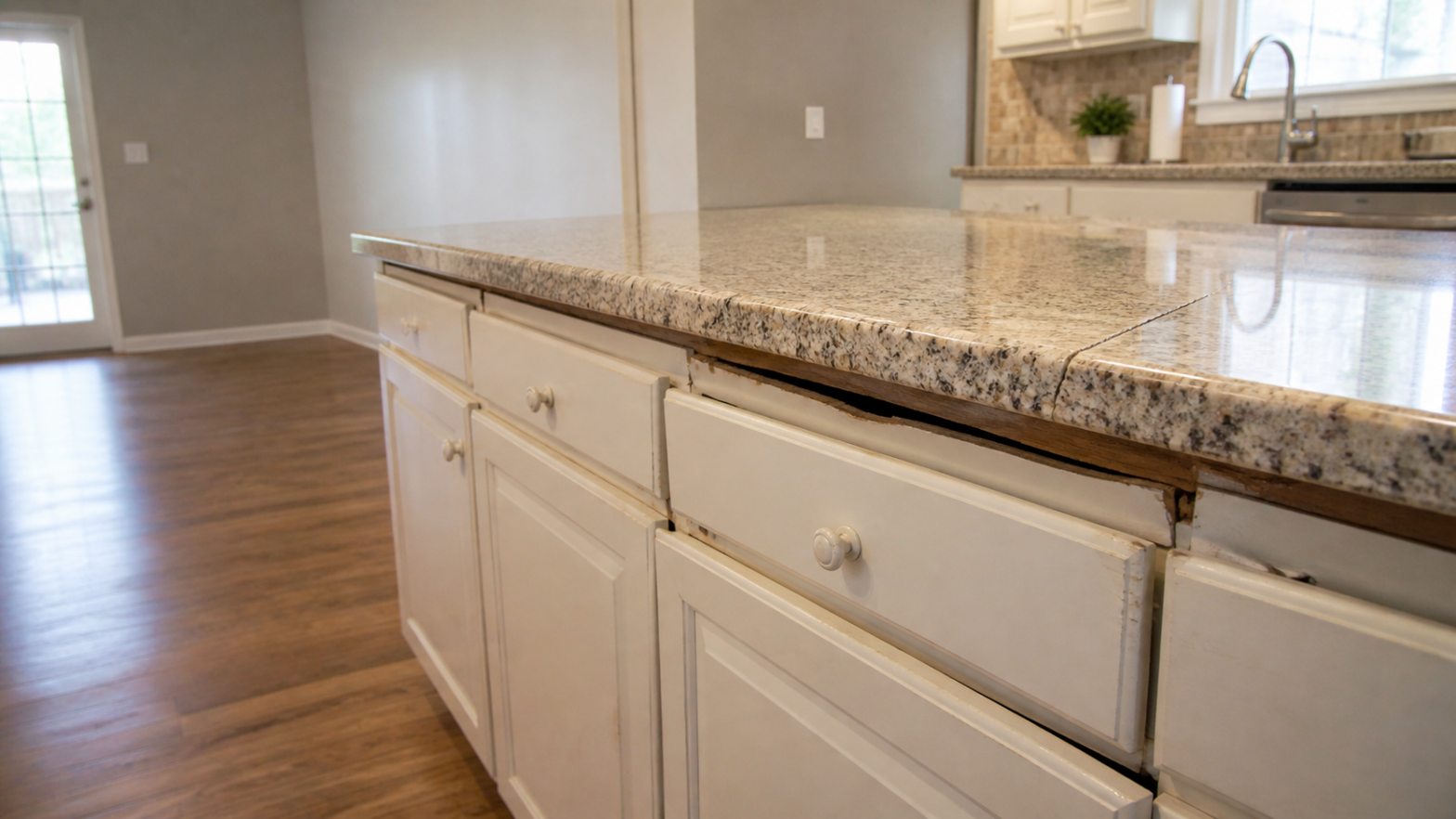
One common reason is cabinet movement. Countertops depend on the cabinets underneath for support. If the cabinets shift, settle, sag, or weaken, the countertop may lose the even support it needs. Over time, this can lead to cracks, seam separation, or uneven surfaces.
Poor installation can also contribute to problems. If a countertop is not properly supported, leveled, or secured, stress may build in certain areas. Heavy materials like granite need stable support across the right points. Without that support, the stone may become more vulnerable to cracking.
Weight distribution matters too. Large countertop overhangs, heavy appliances, or unsupported corners can create stress. This does not mean homeowners need to avoid using their kitchens normally. The countertop and cabinets should be designed to accommodate how the space is used.
In older homes around Dormont, Mt. Lebanon, and the South Hills, kitchens may have undergone several updates over the years. Sometimes new countertops are installed on older cabinets that were not built or reinforced to support the new material. That mismatch can lead to problems later.
Cabinets are the support system for the countertop. If they are not level, strong, and properly aligned, the countertop may not perform as expected.
The countertop is largely considered the main feature, but it relies on what is underneath. Cabinets help distribute weight, keep the surface level, and prevent movement. When cabinets begin to fail, the countertop above can often be the give away sign.
Warning signs include:
You may also notice that drawers stick, cabinet doors swing open, or the countertop appears lower in one area.
Moisture is another concern. If water has damaged the cabinet structure, the material may soften or swell. Once that happens, the countertop may no longer have a steady support base.
This is why countertop decisions should not be made in isolation. A beautiful new countertop can still fail if installed over weak, uneven, or deteriorating cabinets.
Cabinets may be the real problem when countertop damage keeps returning or appears in areas connected to support issues.
A crack that happens once may be due to impact or age. A crack that returns after repair may suggest movement below the surface. The same is true for seam failures. If a seam separates repeatedly, the countertop may be reacting to shifting or uneven cabinets.
Moisture damage inside cabinets is another sign. Look under the sink and around areas where plumbing, dishwashers, or spills may have caused damage. Soft cabinet bottoms, musty smells, swelling, or visible deterioration can all affect countertop stability.
Cabinets may also be at fault if the countertop is no longer level. Even a small amount of cabinet movement can create stress across a rigid countertop material. Over time, that stress may show up as cracks, gaps, or uneven surfaces.
In these cases, replacing the countertop alone may not solve the problem. It may only place a new surface over the same unstable base. A careful inspection can help determine whether the cabinets need adjustment, reinforcement, refacing, or replacement before countertop work begins.
For homeowners considering cabinet updates, Express Cabinet & Granite offers services that can enhance both appearance and function.
Cabinets and countertops do not always need to be replaced at the same time, but in some situations, doing both together makes sense.
If the cabinets are structurally sound, level, and still fit the kitchen layout, they can remain in place while the countertops are replaced. This can be a practical option when the homeowner likes the current cabinet configuration and only wants to update the surface, or when the budget only permits a partial kitchen update.
However, if the cabinets are aging, damaged, poorly aligned, or no longer support the way the kitchen is used, replacing only the countertop may not be the best long-term choice. New countertops are a significant investment and require a stable base.
Replacing cabinets and countertops together often makes sense during a full kitchen remodel, a layout change, or an update in an older home where the cabinets have reached the end of their useful life. It also helps ensure the measurements, support, and design all work together.
In some cases, cabinet refacing or reinforcement may be enough. In others, a full cabinet replacement may be the better option. The right answer depends on the condition of the existing cabinets and the homeowner’s long-term plans.
Repair is usually less expensive upfront than full replacement, but the best value depends on the cause and extent of the damage.
Cleaning, polishing, or sealing is typically the lowest-cost option when the countertop is still in good condition. This may be appropriate for surface staining, dullness, or minor maintenance concerns.
Localized repairs generally cost more than sealing but less than replacement. These may include fixing chips, small cracks, or seams. Repair can be a smart choice when the damage is limited, and the countertop still has years of useful life left.
Full replacement is the largest investment, but it may be the better long-term option when damage is widespread, structural, or tied to an outdated kitchen layout. Replacement may also make sense when repair costs begin to add up or when the countertop material no longer meets the homeowner’s needs.
The important question is not only “What costs less today?” It is also “Which option prevents the same problem from coming back?” A lower-cost repair may not be a good value if cabinet movement, moisture damage, or structural issues remain unresolved.
The lifespan of a kitchen countertop depends on the material, installation quality, maintenance, and the condition of the cabinets underneath.
No countertop material lasts as long as it should if the cabinets below are failing. Moisture, poor installation, cabinet movement, and uneven support can all shorten countertop lifespan.
For homeowners exploring durable material options, Express Cabinet & Granite’s granite services offer a starting point for understanding how granite may fit into a kitchen update.
Before deciding whether to repair or replace countertops, homeowners should look at both the surface and the support system.
Start by identifying the type of damage. Is it a stain, a scratch, a chip, a crack, a seam issue, or an uneven section? Then consider how widespread it is. A single small problem may be repairable. Multiple issues across the kitchen may point toward replacement.
Next, look underneath. Check the cabinets for moisture damage, sagging, loose frames, or alignment problems. Pay close attention to areas around the sink, dishwasher, and corners where stress or water exposure is more common.
It also helps to think about the age of the kitchen and your long-term plans. If you plan to remodel soon, a short-term repair may be enough for now. If you want a long-lasting update, it may be better to address cabinets and countertops together.
A professional evaluation can provide clarity. The goal is not to push every homeowner toward replacement. It is to identify the root cause so the solution actually fits the problem.
Choosing between countertop repair and replacement is easier when you separate cosmetic issues from structural concerns.
A stain, dull spot, or minor chip may not require a major project. Cleaning, resealing, or localized repair may extend the surface’s life. Larger cracks, repeated failures, uneven areas, or widespread damage may point toward replacement.
It is also important to remember that countertops do not stand alone. Cabinets play a major role in stability and long-term performance. If the cabinets underneath are sagging, shifting, or damaged by moisture, replacing the countertop alone may not solve the issue.
For homeowners in Mt. Lebanon, Green Tree, Dormont, and the surrounding South Hills, Express Cabinet & Granite can help evaluate both countertops and the cabinets beneath them. Located on Banksville Road in Pittsburgh, the team can provide guidance based on the condition of the kitchen, your goals, and the most practical next step.
A thoughtful consultation can help you decide whether cleaning, repair, replacement, or cabinet work is the right path forward.
